Is the banh mi the world’s best sandwich?

11:59 PM |
A product of Vietnam’s colonial past, the beloved concoction combines a crunchy French baguette with pork, pate and an ever-changing array of fresh vegetables.

News on Son Doong covers international newspapers
Tay Ninh - weekend destination in the Southeast Region
Vietnam's prison-island paradise

The cab driver stopped on the bustling boulevard Pho Hue and pointed at a mishmash of incongruent four and five-story buildings across the street. I hopped out and dodged buzzing motorbikes and exhaust-belching cars, trying to get from curb to curb.

Then I spotted it: Banh Mi Pho Hue (118 Phố Huế; 84-4-3822-5009), the no-frills sandwich shop named for the Hanoi street on which it sits. Nearly everyone I’d asked had said Banh Mi Pho Hue served the tastiest banh mi in Hanoi. But the family that’s run the shop since 1974 has a reputation for closing it whenever the cooks run out of ingredients. So when I arrived at 7pm on a Saturday and found it still open, I was delighted.

Life in Hanoi. (Hoang Dinh Nam/Getty)

Translated simply as “wheat,” the banh mi is a delicious and ever-varying combination of deli-style pork, pate and veggies (think carrots, cilantro, cucumber, etc), stuffed into a soft and crunchy French baguette. Regional variations in Vietnam involve adding headcheese, pork sausage and various other vegetables.

In an age of hipster food mashups – Korean tacos, anyone? – the banh mi is the product of a true cultural and culinary blend. No food trucks, Instagram photos or tweets led to its creation. The sandwich began with colonialism – specifically, the establishment of French Indochina in 1887 – when the occupying French simply slathered butter and pate inside a baguette. Then when the Vietnamese sent the French packing in 1954, they put their own spin on the sandwich, adding slices of pork, herbs and pickled vegetables, and creating the banh mi as we know it.

The rest of the world didn’t learn about this spectacular sandwich until after the end of the Vietnam War in 1975. As many southern Vietnamese emigrated to the United States, Europe and Australia, they brought recipes, including one for their iconic sandwich. As a result, if you’re eating a banh mi outside of Vietnam, you’re probably enjoying a southern-style snack: the baguettes are generally bigger and they’re crammed with more veggies and herbs, such as cilantro, carrots and hot peppers.

Oddly, the banh mi has always been the one kind of food I liked better outside its home turf. When I tried a banh mi in Ho Chi Minh City a few years earlier, I’d found the bread stale and the ingredients skimpy; inside was a paltry mix of a few slices of ham, a smear of pate and flaccid cilantro and carrots. I gave up after one sandwich. I’d had far better banh mi in New York City; even Minneapolis! Was I crazy? Could the banh mi outside of Vietnam actually be better?  Now back in Vietnam, I was determined to find out the truth. Would my faith in the banh mi in its homeland be restored? Is the banh mi the best sandwich in the world?

A banh mi vendor on a boat in Vietnam. (Jupiter Images/Getty)

At Banh Mi Pho Hue, Geoffrey Deetz – a chef and Vietnamese food expert who’s been living in the country for nearly 15 years – was peppering the sandwich maker with questions about ingredients. Meanwhile, I’d just been served my banh mi, partially covered with piece of white paper affixed with a rubber band.

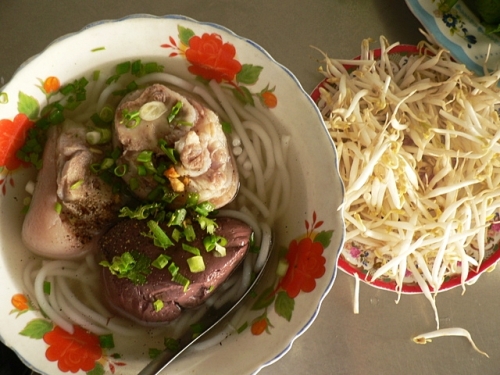
I pulled back a side of the baguette to get a look at the ingredients: pork deli meat, fatty char siu pork, pork floss, creamy pate, Chinese 5 spice and, curiously, butter.  The sandwich maker finished it off by pouring pork-chili gravy inside. Interestingly, I saw none of the herbs and veggies that spill out of the baguettes served in southern Vietnam or outside of the country.

“The banh mi sandwiches in Hanoi are much more one dimensional than other parts of the country,” Deetz told me. “If you gave someone here the kind of over-stuffed, herb-laden sandwich you’ve eaten in other parts of the country, they’d probably throw up.”

Happily, I didn’t throw up. This banh mi was radically different, true. But it was just as good as the sandwiches I’d eaten elsewhere. The crunch of bread was followed by an interplay of porky goodness with a slight kick of spice.  It was more like a meat sandwich. I loved it.

“They don’t really like overly complex food in Hanoi,” Deetz added. “But so many things in here have a function: the pork floss soaks up the sauce, the pate adds moisture and the fact that the baguette is lightly toasted keeps it from getting soggy in this immense humidity.���

A man rides a rickshaw in Hoi An, Vietnam. (Hoang Dinh Nam/Getty)

While in Vietnam, I also tried a banh mi in Hoi An, a Unesco World Heritage-designated city on the central coast. In a region known for fertile soil and vibrant herbs, it’s no surprise the sandwiches there are stuffed with verdant vegetables.

As I did in Hanoi, I asked everyone who would listen where I could find the best banh mi around. The answer was Banh Mi Phuong (‪Phan Chau Trinh 2B) a diminutive shop in the centre of town. I ordered the classic, which the menu board indicated contained “bread, pork, ham, pate”. But there was so much more: long slices of cucumber, fresh cilantro, pickled carrot and even juicy tomato slices. Phoung finished it off with a flurry of sauces: a squirt of chili sauce and two different pork sauces, one from boiled pork and one from smoked pork.

The key to a good banh mi is, in fact, the bread. A bad baguette – a hard, crumbly log – will ruin an otherwise fine sandwich. Phuong’s bread, baked right next door, was ultra-soft, almost deflating when I took a bite, while also maintaining a crispy exterior. Top that (literally) with high-quality pork, two different pork-based sauces and a few surprises like tomato and pickled papaya and I had a very good sandwich in my hands.

All told, I sampled about 15 banh mi sandwiches over two weeks in Vietnam. Happily, I’d eaten some of the best sandwiches I’d ever had. That banh mi I tried in Saigon a few years ago – the one that turned me off to the sandwich for a while – was just a fluke.

But is the banh mi the best sandwich in the world?

There’s scene in The Simpsons in which Homer expresses bewilderment when his daughter, Lisa, becomes a vegetarian.

“What about bacon?” Homer asks.
“No!” Lisa says.
“Ham?”
“No!”
“Pork chops?”
“No!” Lisa says. “Dad, those all come from the same animal!”
“Yeah right,” Homer says. “A wonderful, magical, animal.”

Something that combines so much pork with fresh herbs all stuffed into a crispy baguette is, I have to say, a pretty magical sandwich.
Read more…

Vietnam's prison-island paradise

11:35 PM |
Despite being a quick 45-minute turboprop flight from Ho Chi Minh City, Con Son is a world away from Vietnam’s well-beaten tourist trail, with inexplicably few Western travellers.

News on Son Doong covers international newspapers
Tay Ninh - weekend destination in the Southeast Region
Illegal foreign tourist guides uncontrollable in Vietnam

At 5 am and 6 pm, government loudspeakers crackle to life all over Vietnam. Relics of an era before homes had televisions and radios, these public address systems – broadcasting news, propaganda and weather reports – are usually barely audible above the din of this modern nation: a mix of motorcycle engines, truck horns and construction.

But on Con Son, the news carries loud and clear over the tiny township of just 5,000 residents, two sets of traffic lights and one seaside promenade. Visiting the largest island in the Con Dao archipelago – a group of 16 mostly uninhabited picturesque islands in the South China Sea – is like stepping back in time.

Despite being a short 45-minute turboprop flight from Ho Chi Minh City, the island paradise of Con Son is a world away from Vietnam’s well-beaten tourist trail. It is a throwback that has somehow flown under the radar, escaping the overdevelopment of mainland resort towns like Nha Trang and the party beaches of Phu Quoc. There are no touts, only peaceful empty beaches, and peak season means being just one of a dozen Westerners.

It won't stay this way forever, though. The island's first resort, the ultra-luxe Six Senses Con Dao, opened at Dat Doc Bay on the island's east coast in 2010, and a megaresort is currently under construction in the south. There is also talk of an Italian-backed spiritual retreat, as well as rumours about extending the airport's runway so that bigger planes can land.

Lotus flowers in the morning market (Credit: Tom Westbrook)

But for now, most of the visitors are domestic Vietnamese paying homage to the island’s dark past. Known as Southeast Asia's Devil's Island, Con Son was once a penal colony used to brutal and cruel effect first by French colonists and later during the Vietnam War. The French worked 914 men to death building the island’s jetty, while Vietnam War prisoners were kept in infamous "tiger cages", where captives – actual or suspected Communists – were shackled to the floor of deep concrete pits with steel bars for a roof. The main prison walls still dominate the town as a constant reminder, and the gaols and cemeteries have become pilgrimage sites to the thousands of Vietnamese who suffered and died on the island between 1862 and 1975.

But though the horrific memories hang heavy still, modern island life is languid and laid back. Con Son's steep green interior is fringed by warm turquoise water and coral reefs. Flame trees and bougainvillea give licks of colour to the jungle, and frangipani and magnolia trees line the wide, quiet boulevards. A single main road wraps about halfway around the island; a motorbike ride along the shoreline takes in ponds filled with lotus flowers, spectacular reddish-orange cliffs and one empty white-sand beach after another. The sea is calm, clean and perfect for swimming year-round.

The bustling marketplace will be deserted at noon for naptime (Credit: Tom Westbrook)

The island's daily routine starts at the bustling marketplace, where squid, crabs, clams, rambutans, plantains, mangos, dragonfruit and lotus flowers are piled for sale outside. Inside, young soldiers in jungle greens sit at the food stalls on low plastic chairs, gulping down breakfasts of bun rieu (crab noodle soup) or bun thit nuong (char-grilled pork with vermicelli noodles) while the morning sun floods the doorway. By 9 am, the food is sold out and by noon the market is deserted.

Then, nothing happens until 2 pm, when new afternoon stallholders will arrive, selling roast pork sandwiches, sugarcane juice and rice paper rolls. For two hours, the postmistress goes home, the market is empty, the island naps and the sun beats down on the blue sea. There is nothing to do but swim at one of several beautiful beaches: it doesn't matter where you go, you'll have it to yourself.

Blue paradise on the coast of Nhat Beach (Credit: Tom Westbrook)

If this were the mainland, you might find hourly booze-cruises around the harbour. If you want to see the archipelago from Con Dao, ask around in the evening and you'll be able to hitch a ride with a fisherman early the next day. Slowly putt-putting out of the harbour in a brightly painted blue-and-orange ramshackle boat, the fisherman will likely take you towards the bays and reefs of the tiny outer islands. A snorkel and goggles will be enough to catch a glimpse of a turtle, and the diving is renowned as some of Vietnam's best.

As the heat of the day passes, many travellers choose to explore the island via motorbike.

Blue paradise on the coast of Nhat Beach (Credit: Tom Westbrook)

At An Hai bay, 1km south of Con Son town, pearlers and fishermen moor their boats, keeping coracles –  circular bamboo vessels, waterproofed with coconut-palm resin and propelled by paddle – on the shore as dinghies. For the next 6km, climb the road along the bay until it reaches the island's southmost tip, with views in every direction. The archipelago unfolds to the east; the harbour and Con Son town to the north; the island's rugged and rocky interior to the west.

Hugging the cliffs, the road winds past steep-walled crystal-clear bays and culminates at the island's jewel – the wide flats of Nhat Beach. Here mountains give way to an expanse of deserted white sand that runs hundreds of metres from shore at low tide, with the warm water waist-deep for hundred of metres more. Stay until twilight when the horizon twinkles with the lights of container ships plying the busy South China Sea.

Dusk falls on Con Son's seaside promenade (Credit: Tom Westbrook)

Come evening, Con Son town’s seaside promenade takes its turn as the island's social hub. The sky turns pink and barbecue carts roll up roasting corn, chicken skewers and pork. Swimmers – mostly Vietnamese tourists who shun the sand at daytime – arrive for a dusk dip. The waterfront swells with people.

Across the road from the beach, colonial French villas crumble in various stages of disrepair; their jungled gardens slowly taking over. French composer Camille Saint-Saens stayed in one while he finished work on his opera Brunhilda in 1895; today, that same building is the popular Con Son cafe, which provides only the essentials: beer, ice cream and Vietnamese coffee.

By night, a different market opens on Tran Huy Lieu, two blocks to the east. Half the street is taken over with chairs and metal foldout tables; beer flows as roadside stalls barbecue shellfish, calamari and the rest of the day's catch. It is a delicious way to end the day – with only the nagging thought that the return flight back to the mainland is all too soon.

Clarification: A previous version of this article incorrectly associated the use of Con Son Island during the Vietnam War. This has been amended.
Read more…

Vietnam’s hidden Himalayas

11:00 PM |
The Dong Van district’s Hmong villages and spectacular peaks remain so isolated, foreign tourists are all but unknown.

News on Son Doong covers international newspapers
Vietnam's prison-island paradise
Is the banh mi the world’s best sandwich?


On the road

Google the name “Dong Van” and you won't find much. Until 2013, this mountainous frontier district in Vietnam's northeast corner was under military control and in order to visit, foreigners required special permits that were notoriously difficult to get. “Tourists in Vietnam – if they want to see mountains, they go to Sapa in the northwest,” said Anh Tuan Nguyen, the director of Mototours Asia, a company that offers motorcycle trips throughout the north of Vietnam. “The problem with Sapa is the people are now used to tourists and they are not too interested in being friendly to them. But in Dong Van, the people are still wearing traditional clothes and living traditional lifestyles and are very happy to see you.” With that in mind, I set out from the traffic-choked capital Hanoi on an eight-day guided road trip to Dong Van, riding a vintage Royal Enfield 500cc Bullet motorcycle – and eager to visit a part of Vietnam few foreigners have ever seen. (Ian Lloyd Neubauer)


Curves ahead

The district of Dong Van is so uncharted by Western visitors that many of the roads and mountain ranges have no English translations, making them difficult for travellers to navigate without the help of a local guide. But you don't have to be a local – or a biker – to appreciate the symmetry and engineering of the road leading to Dong Van. Together with Mototours Asia guide Quyen Do Huu, we spent day after day careening around hairpin turns that snaked some 1,500m up colossal mountain ranges. After finding a pass, the road would drop like a bomb into massive canyons carpeted with rice paddies, and it would amble through a village or two before it found another mountain to climb – the dizzying ascent starting all over again. When we left Hanoi, Do Huu told me that Vietnam’s roads and scenery would top even those of Laos, a place many consider a motor biking paradise. On roads like this one, with its peg-threatening curves, negligible traffic and stunning scenery, I realised he was right. (Ian Lloyd Neubauer)


Civilisations built on rice

The further north we travelled, the bigger the mountains became. We rode up to 250km a day across ranges riddled with thousands of rice terraces – an ancient form of agriculture that gave rise to every civilisation to inhabit Vietnam for the past 10,000 years. February marks the middle of the dry season, which accounts for the terraces' brown and earthy tones. But during the monsoon season, from April to October, the terraces light up in bright green and yellow. (Ian Lloyd Neubauer)


Weaving by hand

One of the great draws of exploring Vietnam's northeast is the chance to meet and interact with the Hmong, an ethnic minority that resides in the mountains of Southeast Asia and is often identified by their bright clothing: elaborate dresses, shawls, shirts and scarves, handmade from cotton and hemp fibres that are then dyed with root vegetables in shades of electric pink, red, green and blue. In a world where so many indigenous tribes have capitulated to the convenience of T-shirts and tracksuits, many Hmong girls still learn how to sew and weave tribal motifs passed down to them by their mothers and grandmothers. In this photo, a Hmong woman in traditional dress works an antique loom inside a barn on the outskirts of Yen Minh town, approximately 90km south of Dong Van town – the capital of Dong Van district. (Ian Lloyd Neubauer)


Entering Meo Vac

About 30km south of Dong Van town is Meo Vac, a Soviet-era concrete town surrounded by Hmong villages. With the exception of electricity cables, scooters and ubiquitous mobile phones, the villagers living here still lead traditional lives. Their daily chores include tilling the earth with ox-driven ploughs, fermenting corn to make wine and collecting tinder to warm their homes and cook their rice. This photograph of a Hmong child carrying her baby sister on her back was taken by Do Huu, after he asked to borrow my camera during an afternoon stroll. (Quyen Do Huu)


Meo Vac's famous weekend market

One morning we awoke at 6 am and, in the dark, made our way to Meo Vac's famous weekend market. Dressed in their Sunday best, the Hmong people gathered in the thousands, buying and selling herbs such as ginseng, anise and cinnamon, apples the size of pears, pears the size of melons, the butchered carcasses of pigs, goats and dogs, handmade rice noodles and huge slabs of tofu. They also sold homemade corn wine, a fiery spirit with a vodka-like finish and warm, aromatic flavours. It was here that I saw Western faces for the first time since leaving Hanoi: a retired couple from France travelling around on local minibuses. They were as surprised to see me as I was to see them. (Ian Lloyd Neubauer)


The old Hmong king's palace

About 15km south of Dong Van town in the Sa Phin Valley is Nha Vua Meo: the Palace of the Hmong King, a two-storey four-winged building backed by massive sawtooth cliffs and enclosed in a forest of pines. Built by Chinese tradespeople in 1902 for the Hmong warlord Vuong Chinh Duc, the fortress-like building includes 500mm-thick stone walls set within an 800mm-thick stone barrier, two internal courtyards, 64 bedrooms where the king's wives, children and guard slept, a shrine, armoury, marijuana store – and a large stone block used for lopping off traitors' heads. Only one other Hmong king – communist sympathiser Vuong Chu Sen – lived in the palace before it was abandoned during the Anti-French Resistance War, known in Vietnam as the French War, of 1946 to 1954. Today the palace is run as a museum with a small collection of period artefacts set in dusty glass cases. (Ian Lloyd Neubauer)


Dong Van's Old Quarter

After four days and 900km of arduous riding on our trusty old Enfields, we crawled into Dong Van town just after nightfall. We spent the night in a home stay in the Old Quarter, a maze-like warren of cobblestoned alleyways and century-old flagstone buildings topped off with terracotta tile roofing. The oldest of these homes – a large terrace with two stone-pillar supports festooned with red lanterns – was built by the Luong family between 1810 and 1820 and is still inhabited by their descendants today. It was one of 40 heritage buildings that survived a fire that ravaged Dong Van in 1923, before the French rebuilt the town. (Ian Lloyd Neubauer)


End of the road

Set in the strategic heart of a 1,600m high plateau only 3km from the Chinese border, Dong Van became France's northernmost outpost during the country’s ill-fated 59-year-long colonial occupation of Vietnam. French soldiers used indentured Vietnamese labourers controlled by local kapos (collaborators) to build a large garrison that now lies in ruins on top one of the many karst rock formations overlooking Dong Van town. The garrison can be reached via a steep, roughly 1km goat trail that leads from an alleyway on the eastern boundary of the Old Quarter. This photo was taken from the top of garrison shortly after dawn, when the town was still partly wrapped in the nightly mist. (Ian Lloyd Neubauer)
Read more…

Tay Ninh - weekend destination in the Southeast Region

11:39 PM |
About 100 km from Ho Chi Minh City, Tay Ninh is an interesting destination for weekend.
Conquering the roof of the Southeast
Ba Den Mount.

About 11 kilometers northeast of Tay Ninh City is the Nui Ba relics spanning 24 km², including the three mountains named Heo (Pig) – Phung (Phoenix) - Ba Den.
There are many temples in this area, including Ha, Trung, Thuong, Hang and some temples inside caves. In order to visit these temples, visitors can walk or use the cable car system or slide pipes.
For those who love exploration, to go to the roof of the Southeast region at the elevation of 986m, the only means are their legs.
Tay Ninh Holy See
tay ninh, holy see, dau tieng lake, ba den mount
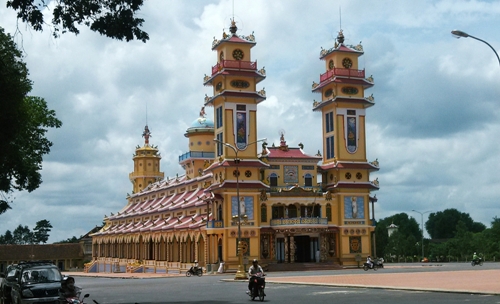
Located in the district of Hoa Thanh, about 5 km south east of Tay Ninh City, Tay Ninh Holy See has unique architecture.
The campus is up to 1.2 km2 with a lot of religious architectures connected with each other by wide roads, with rubber trees alongside.
The Holy See building is 140m long, 40m wide, with three 36m towers, two bell towers of 25m high and dozens of towers of 30m high.
Inside the building are two rows of dragon-shaped pillars. On the ceiling are nine skies with clouds and stars.
Dau Tieng Lake
tay ninh, holy see, dau tieng lake, ba den mount

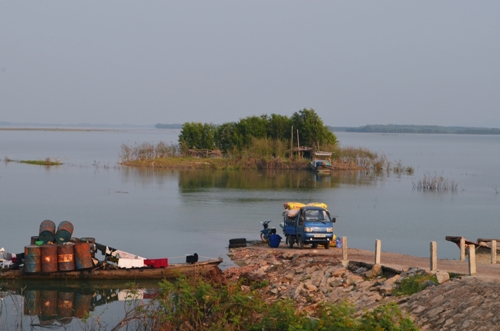
About 20km from the city of Tay Ninh, Dau Tieng Lake covers an area of over 27,000 hectares and contains 1.5 billion cubic meters of water. The lake not only provides water to hundreds of thousands of hectares of agricultural land but it is also a tourist attraction.
There are many small islands in the lake. With beautiful natural landscape and the cool air, the lake is a favorite destination for nature lovers and photographers.
Enjoy the specialties of Tay Ninh

tay ninh, holy see, dau tieng lake, ba den mount

Trang Bang rice cake is the most well-known specialty of Tay Ninh.
Other must-try cuisines include banh canh gio heo (pork noodle) and Nui Ba snails.
You can also buy some specialties of Tay Ninh such as shrimp salt or rice cakes.
Pha Le
Read more…

News on Son Doong covers international newspapers

11:37 PM |
Vietnam’s Son Doong, the world largest cave, has appeared on prestigious international newspapers like The Guardian (the UK), Foxnews (USA), News (Australia) in recent days.
“Son Doong Cave in Vietnam – which is so big it contains a jungle and a river – is now open for public tours. But don't expect it to become crowded: just 224 tourists will be permitted to visit this year,” wrote The Guardian on January 14.
“It's so big you could fit a 40-storey skyscraper inside, but Son Doong cave remained undiscovered until a local man found it in 1991. Even then, no one explored beyond its vast entrance until British cavers visited in 2009,” it wrote.
Meanwhile, FoxNews website wrote: "The Son Doong is over 5.5 miles long and could fit a 40-story skyscraper within its walls. It contains giant stalactites, waterfalls and a jungle that is known as the Garden of Edam with native animals like flying foxes, monkeys and hornbills thriving inside the cavern’s lush landscape.”
News.com.au praised: “Nestled in the wild and remote jungles of the Phong Nha Ke Bang National Park, the Son Doong cave is so big that even the narrower chambers would be able to fit a 40-storey CBD block. In other parts, giant stalagmites climb a staggering 80 meters into the sky and the cave contains some of the world's most dazzling examples of cave pearls.”
Son Doong cave is located in Bo Trach District, Quang Binh Province with a length of 8.8 km, a width of 150m and a depth of 200m. The cave is so great but no one knew about it until 2009, when UK explorers discovered all the beauty inside the cave. Earlier in 1991, a local man discovered it but he did not directly go inside because he found the entrance two deep and steep.
Now, for the first time in history, the cave will be open to the public. A tour company called Oxalis is running trial tours of the cave and accepting sign-ups for real six-day tours to take place next year.
The tours cost $3,000 and include a week of travel inside the cave. Only 220 tourists will be able to visit the cave in 2014. However, the tours to 2016 have been fully booked.
The beauty of Son Doong on The Guardian:
It's so big you could fit a 40-storey skyscraper inside, but Son Doong cave remained undiscovered until a local man found it in 1991. Even then, no one explored beyond its vast entrance until British cavers visited in 2009. All photographs: Ryan Deboodt
 son doong
Ropes and harness are needed to get inside the cave, and any visitors will need to rappel 80 metres to reach the cave floor. Ropes and harness are needed to get inside Son Doong, and any visitors will need to rappel 80 metres to reach the cave floor.
 son doong
Cave Pilot tours took place in August, but so far only 10 people have visited. Oxalis Adventures have been working closely with the government to ensure a sustainable future for the cave: this year they are able to take 224 tourists to Son Doong.
 son doong
Hand of dog The first night of the six-day tour will see visitors camp near the Hand of Dog, a giant stalagmite said to resemble a dog paw.
 son doong
Inside the cave is a huge river - but the source of it remains unknown. In March, a team from the British Cave Research Association who first explored Son Doong will return to try and shed more light on the cave's many mysteries. Photograph: Ran Deboodt Inside the cave is a huge river – but the source of it remains unknown. In March, a team from the British Cave Research Association, who first explored Son Doong, will return to try and shed more light on the cave's many mysteries.
 son doong
Inside the cave is a huge river - but the source of it remains unknown. In March, a team from the British Cave Research Association who first explored Son Doong will return to try and shed more light on the cave's many mysteries. New species of plant have been discovered by scientists within the cave's lush interior.
 son doong
Thousands of Thousands of "cave pearls" sit untouched in Son Doong. These natural phenomenon are formed over hundreds of years when dripping water creates layers of calcite that build up around grains of sand.
son doong
Son Doong contains vast caverns, which fill the 5.5 mile long interior Son Doong contains vast caverns, which fill the 5.5 mile long interior. 
Read more…

Copycat tours slow development of tourism industry

11:36 PM |
As several travel companies struggle to come up with new ideas for tours, many are discouraged to see copycat companies take their ideas almost immediately.
Founders of new trekking tours blaze trails 
Creating a new tour can take a great deal of time, effort and research. Tran The Dung, Deputy Director of The He Tre Travel Firm in HCM City, conducted a study for a new tour in the northern province of Dien Bien in 2007. He and a friend had to climb 1,864-metres up Khoang La San Mountain to the border line with Laos and China, in Xin Thau Commune in Dien Bien Province.
Using dangerous and rocky roads, they got lost and accidentally crossed into China by 250 metres. Luckily, they realised their mistake and got back on course before meeting any Chinese border guards.
He continued to conduct another study from the mountainous district of Bac Quang to Hong Su Phi in the north-western province of Ha Giang, through Y Ty plateau in Lao Cai Province’s Bat Xat District, which is 1,600 metres high.
 “When we got to Y Ty, it’s was 9pm and our motorbike had broken down, forcing us to walk. We saw a wild snake on the road, forcing us to wait for nearly 20 minutes for it to go away,” he recalled.
Before introducing a northeastern tour, it took him three years of research to arrange proper means of transport for tourist to travel across Gam and Nang Rivers, as water levels on the rivers change regularly depending on a nearby hydropower plant.
The General Tourism Administration’s Famtrip started research for a tour to Co To Island in the northern province in 2006. However, travel could not begin until 2013 due to a lack of standard accommodation and services.
Lao Cai,Dien Bien, tourism industry, Co To Island
Dong Van Market, a favourite destination of northeastern tours
Despite much effort and time spent on starting a new tour, those who pioneer often do not benefit the most from their products because of imitation. Just a short time after they launched a new tour, several other travel firms offered their same tour schedules. They were forced to discount their prices to attract more customers.
The situation discourages those who would otherwise open up new areas to tourism from putting in the necessary work.  
An anonymous manager of a travel firm in the North admitted that a new tour quickly becomes popular just a short time after the launch, benefiting many other travel firms.
“While the founder makes a great effort to set up a new tour, they do no benefit much due to fierce competition after the tour is launched," he commented.
"This type of imitation is the cause of the lack of unique and creative products, and hinders development of tourism in Vietnam," Dung added.
Read more…

Hanoi’s favorite coffee shops

1:08 AM |
Whether you are an art, music or architecture enthusiast, you can find a suitable coffee shop in Hanoi as a way to help sublimate your interests.
Watching Hanoi from above

Quiet, airy and spacious views are the reason why many tourists come to the rooftop cafes. The roofs and balconies of buildings around West Lake and Hoan Kiem Lake are home to many cafes with the best views. These include Avalon Cafe Lounge on Cau Go Street, Illy Café on Le Thai To Street, and Summit Lounge on Thanh Nien Road. However, if you are looking for a place to enjoy a cup of coffee and the ancient beauty of the Hanoi Cathedral, Hanoi House is not a bad choice.
Nestled in a small alley, on the second floor of a house on Ly Quoc Su Street, the balcony of Hanoi House attracts many in the Hanoi Cathedral area, and is a favorite spot of those who want to gaze at the church. With simple ceramic chairs, this cafe is quiet enough to watch the streets of Hanoi and high enough to admire the panoramic view.
Music playground

hanoi cafe, coffee shops
Enjoying a cup of coffee and listening to favorite songs is the way many people pass a relaxing evening. If you like international songs, you should go to Hanoi Social Club. Though it is not purely a cafe, with simple but close design style and music events that are held weekly, this is a Hanoi address that you should not miss.
The club is a three-story, ancient French-styled house on Hoi Vu Road. The first floor is home to musical feasts with the participation of artists from many countries. The second and third floors are where you can find your own silent space.
Besides Hanoi Social Club, there are many cafes with live music, such as Polygon Café on Nui Truc Street, for rock music lovers, or Cuoi Ngo Café in Cau Giay District for those who love the haunting ballads of Trinh Cong Son. Depending on your tastes, you can choose a suitable space.
Ancient French space

hanoi cafe, coffee shops

For those who love Western classic and modern architecture, the cafes in old French villas have their own charm.
At Chuon Chuon (Dragonflies) Café on Hoi Vu Street, tourists feel the European classical style from the entrance, the stairs to the 2-story house with large windows.
You can also enjoy French architectural space at the Bar Betta on Cao Ba Quat Street, Unicorn's Home Café in Ly Thuong Kiet Streets. Though they are located inside old villas, these cafes are different in design and furniture.
Cafes in the Old Quarter

hanoi cafe, coffee shops

Though you may pass Hang Gai Street every day, if you don’t pay attention, it is difficult to recognize the signboard of Ca Phe Pho Co shop, located in a small alley. Following a small path, visitors step into the garden courtyard with light shining inward. Mixed in every corner of the walls, sills and stairs are antiques.
To admire the museum space of this cafe, you have to climb up to the second floor, which is connected by a small red bridge. Sip a cup of coffee and enjoy the quiet space, and you will feel the beauty of an ancient Hanoi in this small place.
However, this is not the only place where you can come back to Hanoi in memory. There are many addresses you can visit, such as Dinh Café on Dinh Tien Hoang Street, Giang café on Nguyen Huu Huan Road and Nang café on Hang Bac Street
Art destinations

hanoi cafe, coffee shops

Manzi is located in an old French village on the quiet street of Phan Huy Ich. In addition to enjoying drinks, diners are immersed in a contemporary art space with experimental music. The first floor of Manzi is decorated with many contemporary art works.
If you're a fan of pictures and photos, besides Manzi, you can go to Lam Café on Nguyen Huu Huan Street or Art Talk Cafe on Quan Su Road to experience art spaces.
Read more…

Laminating gold by hand in Hanoi’s old village

1:07 AM |
1/10 tael of gold can be laminated into a sheet of 1m2. The sheet is then cut into small square pieces of 1cm long to inlay on worshipping items.
Visiting historical relics and temples, visitors often see the gilded Buddha statues, horizontal lacquered boards and parallel sentences. Over a long period of time, these worshipping items are still beautiful. Most of them were made by talented hands of artisans in Kieu Ky village, Gia Lam district, Hanoi.
Over 500 years ago, Nguyen Quy Tri who lived during the Anterior Le Dynasty (1428- 1527) passed the craft down to Kieu Ky locals. Descendants of those locals now take his date of death, the 17th  day of the eighth lunar month, as the annual chance to show their gratitude to the ancestor of the craft.
Craftsmen often start their work in the new year on the 14th day of the first lunar month with a ceremony, during which a famous and skilled man, often ready to help villagers, is given the honor of making the first hammer strikes.
Kieu Ky is the only village in Vietnam where the sheets are made from pure gold and silver, called old sheets, used exclusive for products in the village. Craftsmen only make decorative sheets from tin, called new sheets, outside the village where they go to practice the craft. Each household puts its own distinguishing characteristics on the products. That  is why craftsmen can easily pinpoint who the manufacturers of the works are among their fellow villagers.
Coming to Kieu Ky, visitors find themselves in the busy life of the locals. Most of the villagers are peasants, but they hardly have any free time because, over 50 households engaged in the craft employ hundreds of the old and young alike.
Vu Thi Dac, 75, who has spent over 60 years in the craft, said : “this job requires experience, technique and sophisticated work before becoming a sheet.” First, pine resin is mixed with gelatin glue processed from buffalo skin. The  mixture is then mixed with special raw paper pulp, then cut cut  into 4cm x 6cm pieces. Small pieces of gold, sandwiched between those sheet, are hammered for nearly an hour before becoming a complete products.
The last stage of the work is to take the gold sheets out of the “moulds”, but this is by no means a simple task, as only a gentle breath would be enough to blow them away.
In recent years, together with the growth of the economy, various pagodas, and shrines are being  restored, creating a chance for the development of the craft in Kieu Ky, as the demand for  the sheets skyrockets.
Large volumes of the sheets are exported to Japan and Thailand, and this injects a new vitality to the craft. Kieu Ky craftsmen can feel proud because they have successfully restored and developed the unique legacy passed down to them by their ancestors.
Gilded Buddha statues.
kieu ky, gilded, gold inlaid
To inlay gold on these items, workers use “la quy” – a special material made from giay do (do paper – made from the bark of the Rhamnoneuron balansae), covered by a special ink made from pine resin, sawdust, glue and buffalo leather glue. A completed “la quy” must be covered with this mixture thrice and dried. Melted gold and silver is casted into thin sheets and then put between “la quy” and laminated into thinner sheets. In photo: Completed “la quy”.
kieu ky, gilded, gold inlaid
Silver sheets.
kieu ky, gilded, gold inlaid
Nearly 50 families in Kieu Ky produce “la quy”. Some families hire more than 20 workers.
kieu ky, gilded, gold inlaid
1/10 tael of gold can be laminated into a thousand sheets, covering 1sq.m of area. After gold sheets are added between “la quy”, workers have to wrap “la quy” by a cloth and hammer it to have thinner gold sheets. This is an important stage, deciding the color of gold sheets. This step takes about an hour.
kieu ky, gilded, gold inlaid
Gold sheets are added between “la quy”. This step is called "long quy".
kieu ky, gilded, gold inlaid
It takes about 30-45 minutes to hammer a “la quy”.
kieu ky, gilded, gold inlaid
The final products: Each “quy” consists of 400-500 sheets of gold.
kieu ky, gilded, gold inlaid
The stage called “trai quy” is also difficult. Workers have to take gold sheets in a very carefully way so gold sheets are not torn or stick to each other.
kieu ky, gilded, gold inlaid
After hammering, workers cut gold sheets into small square pieces of 1cm.
kieu ky, gilded, gold inlaid
This is a meticulous work.
kieu ky, gilded, gold inlaid
One of the typical gilded products of Kieu Ky village is the Bodhisattva Kwan Yin statue at But Thap Pagoda. This statue was made in 1656 and until now it is still beautiful thanks to the gold layer inlaid by Kieu Ky workers.
kieu ky, gilded, gold inlaid
Or the horizontal lacquered board and parallel sentences at Kim Ngan Temple in Hang Bac Street, Hanoi.
Read more…

Unique cafe with reptiles in Saigon

1:05 AM |
With drinks priced at only VND15,000-VND28,000 ($0.7-1.2)/ glass, the coffee shop on Hoa Phuong Road, in Ho Chi Minh City’s Phu Nhuan District, uses reptiles like pythons, snakes, and South America dragons to attract tourists.
The shop’s menu is impressive, with pictures of reptiles. The shop just opened but it has attracted many visitors, especially the young and, of course, those who love reptiles.
reptile cafe, saigon
Customers are guided how to play with reptiles.

reptile cafe, saigon
A boy says: "It is interesting to look at and play with the reptiles that I could only see on TV or the internet right here".

reptile cafe, saigon
Customers enjoy coffee next to a gentle python.

reptile cafe, saigon
A python wraps its body around glasses.

reptile cafe, saigon
A young customer plays with a python.

reptile cafe, saigon
The shop is open from 8 to 23h every day, with prices from VND15,000 to VND28,000/glass, which is reasonable for students and young people.

reptile cafe, saigon
This South African dragon is a Savannah Monitor. This is the most expensive species in this shop, from VND3 to VND10 million ($150-500)/head. Other species are priced from VND500,000 to several million dong.

reptile cafe, saigon
Green Iguana sourced from South America. Their major food is vegetables and fruits. They are considered mini dinosaurs at home.

reptile cafe, saigon
Milk snakes are gentle.

reptile cafe, saigon
A colorful frog.

reptile cafe, saigon
A customer takes pictures with a South African dragon.

reptile cafe, saigon

reptile cafe, saigon
Customers can feed them.

reptile cafe, saigon
Mr. Tuan, the owner of this café – a reptile lover – says that the pets at the café come from members of the reptile club in HCM City, with the hope to transmit a love of reptiles to others.
Read more…